 Add to Chrome
 Add to Firefox
 Add to Edge
SentGuard: Sentence-Level Streaming Guardrails for Large Language Models
Jun 01, 2026
Large language models increasingly stream long, reasoning-intensive responses in real time, making when to moderate as critical as whether to moderate. Existing guardrails fall into two unsatisfactory extremes: response-level methods delay intervention until the full output is generated, whereas token-level methods act on incomplete semantics, often producing unstable decisions and excessive guard invocations. To address this challenge, we propose SentGuard, a sentence-level streaming guardrail that operates in parallel with generation. A lightweight waiting buffer groups streamed tokens into sentence chunks and releases only verified chunks to the user, introducing a small offset that enables SentGuard to assess the current prefix while the target LLM decodes subsequent content. To support this, we construct StreamSafe, a benchmark with structured per-sentence annotations across 8 harm categories, capturing the evolution of safety risks across both reasoning and response segments. We further train SentGuard with a coarse-to-fine objective to detect unsafe intent as soon as it emerges at sentence boundaries. Experiments on 5 safety benchmarks show that SentGuard outperforms existing baselines, detecting 90.5% of unsafe cases within two sentences while maintaining a low streaming false-positive rate of 7.41%.

BraveGuard: From Open-World Threats to Safer Computer-Use Agents
May 31, 2026Computer-use agents extend language models from text generation to sustained interaction with files, terminals, browsers, and external tools. This shift creates safety risks that are difficult to detect from isolated prompts or final responses, because harm often emerges only through multi-step execution traces whose individual actions appear locally benign. We introduce BraveGuard, a self-evolving defense framework for training guard models from open-world threat signals and realistic agent trajectories. BraveGuard mines recent research sources to identify emerging risks and attack patterns, instantiates them as executable computer-use tasks, collects agent rollouts, and derives trajectory-level supervision for guard model training. As new threats and validation failures appear, the pipeline can be repeated, yielding an adaptive defense loop rather than a static, benchmark-driven training process. We instantiate BraveGuard by training multiple guard backbones, including Qwen3-Guard and Llama-Guard variants, and evaluate the resulting guards on trajectory-level agent-safety benchmarks. BraveGuard consistently improves safety detection across computer-use trajectories. On AgentHazard, it substantially improves detection accuracy over off-the-shelf guard models, with accuracy increasing from 38.79% to 82.38% under the averaged guard-model setting. These results show that guard supervision grounded in open-world threat discovery and realistic agent execution can improve safety monitoring beyond fixed taxonomies and synthetic prompt-level data. BraveGuard offers a scalable path toward adaptive defenses for computer-use agents facing evolving real-world risks.
Towards Context-Invariant Safety Alignment for Large Language Models
May 20, 2026Preference-based post-training aligns LLMs with human intent, yet safety behavior often remains brittle. A model may refuse a harmful request in a standard prompt but comply when the same intent is wrapped in adversarial wording. We suggest that robust safety requires context-invariant alignment, where behavior depends on the underlying intent rather than surface form. Enforcing invariance is difficult in alignment because not all training signals are equally trustworthy; for some prompt variants we can obtain verifiable feedback (e.g., multiple-choice), while for open-ended variants we typically rely on noisy, gameable reward proxies (e.g., learned judges). As a result, standard symmetric invariance regularizers can reduce cross-context discrepancies by lowering performance on reliable variants instead of improving open-ended robustness. To address this, we introduce Anchor Invariance Regularization (AIR), which treats verifiable prompts as anchors and uses a stop-gradient target to regularize only the open-ended variants toward the anchor performance. AIR is implemented as a plug-in auxiliary loss and combined with group-based preference optimization (e.g., GRPO) via heterogeneous prompt grouping. Across Safety, Moral Reasoning, and Math, AIR improves context invariance, boosting in-distribution group accuracy by 12.71% and out-of-distribution consistency by 33.49%, making safety constraints robust to adversarial framings.
A Safety Report on GPT-5.2, Gemini 3 Pro, Qwen3-VL, Grok 4.1 Fast, Nano Banana Pro, and Seedream 4.5
Jan 16, 2026The rapid evolution of Large Language Models (LLMs) and Multimodal Large Language Models (MLLMs) has driven major gains in reasoning, perception, and generation across language and vision, yet whether these advances translate into comparable improvements in safety remains unclear, partly due to fragmented evaluations that focus on isolated modalities or threat models. In this report, we present an integrated safety evaluation of six frontier models--GPT-5.2, Gemini 3 Pro, Qwen3-VL, Grok 4.1 Fast, Nano Banana Pro, and Seedream 4.5--assessing each across language, vision-language, and image generation using a unified protocol that combines benchmark, adversarial, multilingual, and compliance evaluations. By aggregating results into safety leaderboards and model profiles, we reveal a highly uneven safety landscape: while GPT-5.2 demonstrates consistently strong and balanced performance, other models exhibit clear trade-offs across benchmark safety, adversarial robustness, multilingual generalization, and regulatory compliance. Despite strong results under standard benchmarks, all models remain highly vulnerable under adversarial testing, with worst-case safety rates dropping below 6%. Text-to-image models show slightly stronger alignment in regulated visual risk categories, yet remain fragile when faced with adversarial or semantically ambiguous prompts. Overall, these findings highlight that safety in frontier models is inherently multidimensional--shaped by modality, language, and evaluation design--underscoring the need for standardized, holistic safety assessments to better reflect real-world risk and guide responsible deployment.
OpenRT: An Open-Source Red Teaming Framework for Multimodal LLMs
Jan 04, 2026The rapid integration of Multimodal Large Language Models (MLLMs) into critical applications is increasingly hindered by persistent safety vulnerabilities. However, existing red-teaming benchmarks are often fragmented, limited to single-turn text interactions, and lack the scalability required for systematic evaluation. To address this, we introduce OpenRT, a unified, modular, and high-throughput red-teaming framework designed for comprehensive MLLM safety evaluation. At its core, OpenRT architects a paradigm shift in automated red-teaming by introducing an adversarial kernel that enables modular separation across five critical dimensions: model integration, dataset management, attack strategies, judging methods, and evaluation metrics. By standardizing attack interfaces, it decouples adversarial logic from a high-throughput asynchronous runtime, enabling systematic scaling across diverse models. Our framework integrates 37 diverse attack methodologies, spanning white-box gradients, multi-modal perturbations, and sophisticated multi-agent evolutionary strategies. Through an extensive empirical study on 20 advanced models (including GPT-5.2, Claude 4.5, and Gemini 3 Pro), we expose critical safety gaps: even frontier models fail to generalize across attack paradigms, with leading models exhibiting average Attack Success Rates as high as 49.14%. Notably, our findings reveal that reasoning models do not inherently possess superior robustness against complex, multi-turn jailbreaks. By open-sourcing OpenRT, we provide a sustainable, extensible, and continuously maintained infrastructure that accelerates the development and standardization of AI safety.
Evolve the Method, Not the Prompts: Evolutionary Synthesis of Jailbreak Attacks on LLMs
Nov 16, 2025Automated red teaming frameworks for Large Language Models (LLMs) have become increasingly sophisticated, yet they share a fundamental limitation: their jailbreak logic is confined to selecting, combining, or refining pre-existing attack strategies. This binds their creativity and leaves them unable to autonomously invent entirely new attack mechanisms. To overcome this gap, we introduce \textbf{EvoSynth}, an autonomous framework that shifts the paradigm from attack planning to the evolutionary synthesis of jailbreak methods. Instead of refining prompts, EvoSynth employs a multi-agent system to autonomously engineer, evolve, and execute novel, code-based attack algorithms. Crucially, it features a code-level self-correction loop, allowing it to iteratively rewrite its own attack logic in response to failure. Through extensive experiments, we demonstrate that EvoSynth not only establishes a new state-of-the-art by achieving an 85.5\% Attack Success Rate (ASR) against highly robust models like Claude-Sonnet-4.5, but also generates attacks that are significantly more diverse than those from existing methods. We release our framework to facilitate future research in this new direction of evolutionary synthesis of jailbreak methods. Code is available at: https://github.com/dongdongunique/EvoSynth.
A Rigorous Benchmark with Multidimensional Evaluation for Deep Research Agents: From Answers to Reports
Oct 02, 2025Artificial intelligence is undergoing the paradigm shift from closed language models to interconnected agent systems capable of external perception and information integration. As a representative embodiment, Deep Research Agents (DRAs) systematically exhibit the capabilities for task decomposition, cross-source retrieval, multi-stage reasoning, and structured output, which markedly enhance performance on complex and open-ended tasks. However, existing benchmarks remain deficient in evaluation dimensions, response formatting, and scoring mechanisms, limiting their capacity to assess such systems effectively. This paper introduces a rigorous benchmark and a multidimensional evaluation framework tailored to DRAs and report-style responses. The benchmark comprises 214 expert-curated challenging queries distributed across 10 broad thematic domains, each accompanied by manually constructed reference bundles to support composite evaluation. The framework enables comprehensive evaluation of long-form reports generated by DRAs, incorporating integrated scoring metrics for semantic quality, topical focus, and retrieval trustworthiness. Extensive experimentation confirms the superior performance of mainstream DRAs over web-search-tool-augmented reasoning models, yet reveals considerable scope for further improvement. This study provides a robust foundation for capability assessment, architectural refinement, and paradigm advancement in DRA systems.
SafeWork-R1: Coevolving Safety and Intelligence under the AI-45$^{\circ}$ Law
Jul 24, 2025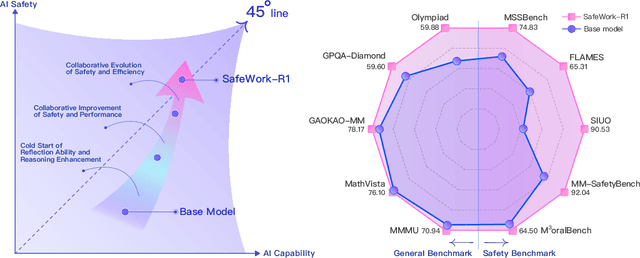
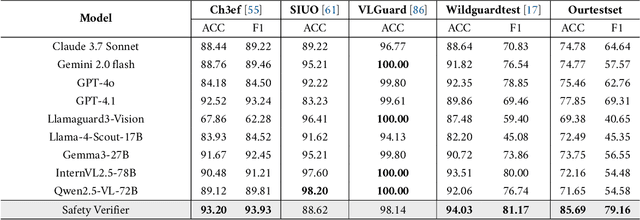
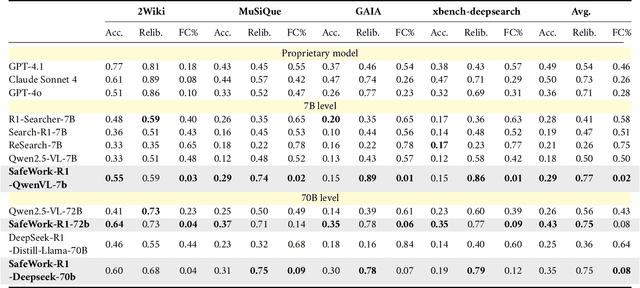
We introduce SafeWork-R1, a cutting-edge multimodal reasoning model that demonstrates the coevolution of capabilities and safety. It is developed by our proposed SafeLadder framework, which incorporates large-scale, progressive, safety-oriented reinforcement learning post-training, supported by a suite of multi-principled verifiers. Unlike previous alignment methods such as RLHF that simply learn human preferences, SafeLadder enables SafeWork-R1 to develop intrinsic safety reasoning and self-reflection abilities, giving rise to safety `aha' moments. Notably, SafeWork-R1 achieves an average improvement of $46.54\%$ over its base model Qwen2.5-VL-72B on safety-related benchmarks without compromising general capabilities, and delivers state-of-the-art safety performance compared to leading proprietary models such as GPT-4.1 and Claude Opus 4. To further bolster its reliability, we implement two distinct inference-time intervention methods and a deliberative search mechanism, enforcing step-level verification. Finally, we further develop SafeWork-R1-InternVL3-78B, SafeWork-R1-DeepSeek-70B, and SafeWork-R1-Qwen2.5VL-7B. All resulting models demonstrate that safety and capability can co-evolve synergistically, highlighting the generalizability of our framework in building robust, reliable, and trustworthy general-purpose AI.
JailBound: Jailbreaking Internal Safety Boundaries of Vision-Language Models
May 26, 2025Vision-Language Models (VLMs) exhibit impressive performance, yet the integration of powerful vision encoders has significantly broadened their attack surface, rendering them increasingly susceptible to jailbreak attacks. However, lacking well-defined attack objectives, existing jailbreak methods often struggle with gradient-based strategies prone to local optima and lacking precise directional guidance, and typically decouple visual and textual modalities, thereby limiting their effectiveness by neglecting crucial cross-modal interactions. Inspired by the Eliciting Latent Knowledge (ELK) framework, we posit that VLMs encode safety-relevant information within their internal fusion-layer representations, revealing an implicit safety decision boundary in the latent space. This motivates exploiting boundary to steer model behavior. Accordingly, we propose JailBound, a novel latent space jailbreak framework comprising two stages: (1) Safety Boundary Probing, which addresses the guidance issue by approximating decision boundary within fusion layer's latent space, thereby identifying optimal perturbation directions towards the target region; and (2) Safety Boundary Crossing, which overcomes the limitations of decoupled approaches by jointly optimizing adversarial perturbations across both image and text inputs. This latter stage employs an innovative mechanism to steer the model's internal state towards policy-violating outputs while maintaining cross-modal semantic consistency. Extensive experiments on six diverse VLMs demonstrate JailBound's efficacy, achieves 94.32% white-box and 67.28% black-box attack success averagely, which are 6.17% and 21.13% higher than SOTA methods, respectively. Our findings expose a overlooked safety risk in VLMs and highlight the urgent need for more robust defenses. Warning: This paper contains potentially sensitive, harmful and offensive content.
SafeVid: Toward Safety Aligned Video Large Multimodal Models
May 17, 2025As Video Large Multimodal Models (VLMMs) rapidly advance, their inherent complexity introduces significant safety challenges, particularly the issue of mismatched generalization where static safety alignments fail to transfer to dynamic video contexts. We introduce SafeVid, a framework designed to instill video-specific safety principles in VLMMs. SafeVid uniquely transfers robust textual safety alignment capabilities to the video domain by employing detailed textual video descriptions as an interpretive bridge, facilitating LLM-based rule-driven safety reasoning. This is achieved through a closed-loop system comprising: 1) generation of SafeVid-350K, a novel 350,000-pair video-specific safety preference dataset; 2) targeted alignment of VLMMs using Direct Preference Optimization (DPO); and 3) comprehensive evaluation via our new SafeVidBench benchmark. Alignment with SafeVid-350K significantly enhances VLMM safety, with models like LLaVA-NeXT-Video demonstrating substantial improvements (e.g., up to 42.39%) on SafeVidBench. SafeVid provides critical resources and a structured approach, demonstrating that leveraging textual descriptions as a conduit for safety reasoning markedly improves the safety alignment of VLMMs. We have made SafeVid-350K dataset (https://huggingface.co/datasets/yxwang/SafeVid-350K) publicly available.